
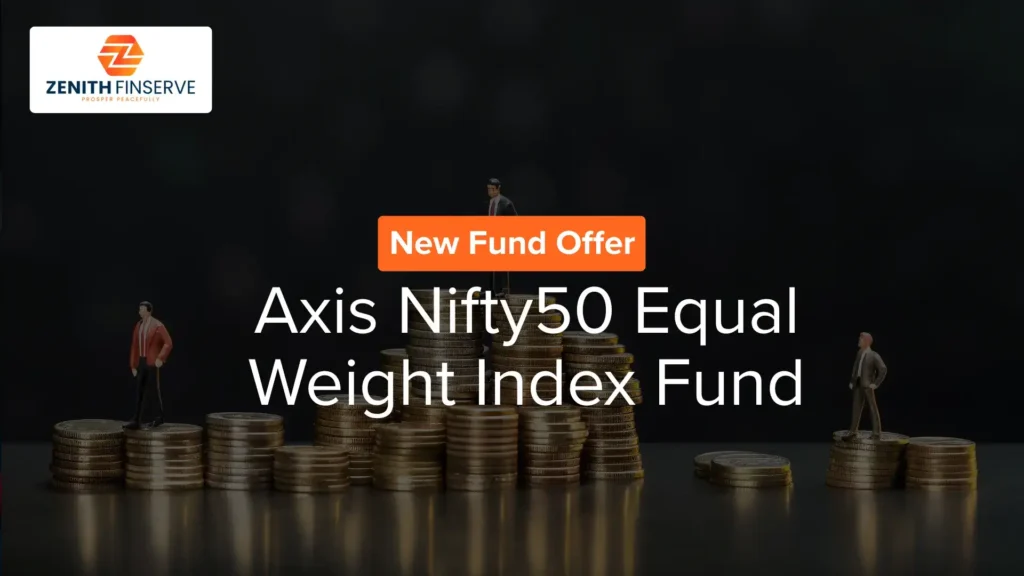
Axis Mutual Fund launched the Axis Nifty50 Equal Weight Index Fund, an open-ended scheme tracking the Nifty50 Equal Weight TRI. The NFO runs from 3 July 2026 to 17 July 2026.
The fund provides equal allocation to all 50 index companies, avoiding the large-cap concentration of traditional market-cap-weighted funds.
Axis Nifty50 Equal Weight Index Fund Details
Particular | Details |
Fund name | Axis Nifty50 Equal Weight Index Fund |
Fund type | Open ended Index Fund |
Category | Index Fund |
Benchmark | Nifty50 Equal Weight TRI |
Fund managers | Nandik Malik, Rohit Gautam |
NFO open date | 3-July-2026 |
NFO close date | 17-July-2026 |
Allotment/Reopening date | 23-July-2026 |
Minimum investment | ₹100/- |
Additional investment | ₹100/- |
SIP | ₹100/- |
NAV | ₹10/- |
Stamp duty | 0.005% |
Entry load | Nil |
Exit load | 0.25% if redeemed or switched out within 15 days from allotment. Nil thereafter. |
Company details
Particular | Details |
AMC name | Axis Asset Management Company Ltd. |
AUM | ₹3,77,815 Crores |
Website | |
Address | One Lodha Place, 22nd & 23rd Floor, Senapati Bapat Marg, Lower Parel, Mumbai 400013 |
Contact number | 8108622211, (022) 63111001 |
Source: AMFI InAxis Nifty50 Equal Weight Index Funddia New Fund Offer
What has Axis Mutual Fund launched?
Axis Mutual Fund has introduced an index fund that tracks the Nifty50 Equal Weight TRI.
The benchmark contains the same 50 companies that are part of the Nifty 50 Index. Instead of assigning larger weights to bigger companies based on market capitalisation, every company receives an equal allocation at each scheduled rebalancing.
How does the strategy work?
A traditional Nifty 50 index gives more importance to the largest companies. This means companies with larger market values have a greater influence on the index’s performance.
An equal weight index follows a different approach. Every company starts with the same allocation, irrespective of its size. As stock prices change, the weights drift over time and are periodically reset through index rebalancing.
Step by step
Step | What happens? |
1 | The fund tracks the Nifty50 Equal Weight TRI. |
2 | It invests in the same 50 companies that are part of the index. |
3 | Each company receives approximately equal allocation at rebalancing. |
4 | The portfolio changes whenever the benchmark index changes or is rebalanced. |
5 | The objective is to closely match the benchmark’s performance while keeping tracking error low. |
Let’s see through an example
Suppose the index contains 50 companies. In an equal weight index, every one of the 50 companies starts with roughly 2% allocation.
In case one company performs exceptionally well, its weight gradually increases. The index reduces that weight back towards the equal allocation and redistributes the difference across other companies during the next scheduled rebalance.
Potential benefits
Potential benefit | Why does it matter? |
Diversified exposure | The fund invests across all 50 companies in the Nifty50 Equal Weight Index. |
Equal allocation | Every constituent receives equal weight at each rebalancing, reducing concentration in the largest companies. |
Passive investment approach | The portfolio follows a predefined index instead of depending on active stock selection. |
Transparent strategy | Investors know which index the fund follows and how the portfolio is constructed. |
Automatic rebalancing | The underlying index periodically restores equal weights across all constituents. |
Simple investment process | Investors get exposure to leading listed companies through a single mutual fund. |
What are the key risks?
Risk | What does it mean? |
Market risk | The value of the fund can rise or fall as equity markets move. |
Tracking error | The fund’s returns may differ slightly from the benchmark because of expenses, cash holdings, corporate actions or portfolio adjustments. |
Equal weight index risk | Equal weighting may perform differently from a market capitalisation weighted index during different market cycles. |
Corporate action risk | Mergers, demergers and other corporate actions can temporarily affect portfolio replication. |
Who may consider this fund?
Investor type | Why? |
Investors seeking passive investing | The scheme tracks an index instead of relying on active stock selection. |
Long term equity investors | The fund provides diversified equity exposure through a rule based strategy. |
Investors looking beyond market capitalisation weighting | Equal weighting provides similar exposure to every company in the benchmark. |
Investors building a diversified portfolio | The fund can provide exposure to large listed companies through a single investment. |
Who may not find it suitable?
Investor type | Why? |
Investors looking for guaranteed returns | Mutual fund returns depend on market performance. |
Investors with very short investment horizons | Equity markets may remain volatile over shorter periods. |
Investors seeking regular fixed income | The scheme focuses on equity investments rather than generating predictable income. |
Investors uncomfortable with market fluctuations | The NAV can move up or down based on equity market conditions. |
Axis Nifty50 Equal Weight Index Fund vs traditional investment options
Investment option | Return potential | Risk | Complexity |
Fixed Deposit | Low | Low | Low |
Debt Mutual Fund | Low to Moderate | Low to Moderate | Moderate |
Hybrid Mutual Fund | Moderate | Moderate | Moderate |
Equity Mutual Fund | Moderate to High | High | Moderate to High |
Axis Nifty50 Equal Weight Index Fund | Market linked | High | Low to Moderate as it follows a passive equal weight index strategy |
Zenith Finserve’s view
The Axis Nifty50 Equal Weight Index Fund tracks Nifty 50 companies but assigns them equal weights during periodic rebalancing, rather than basing allocation on company size.
Suitability depends on your goals, risk tolerance, and current holdings. As a passive equity investment, it remains subject to market volatility and should be viewed as one component of a broader portfolio.
How can Zenith Finserve help?
At Zenith Finserve, we follow a process driven investment framework. We assess your goals, cash flows, risk profile, time horizon, existing investments, loans, and tax situation before suggesting investments.
We align our investment suggestions to match your needs. Then, we review them periodically to keep them aligned with your changing life and financial position.
Frequently asked questions (FAQs)
What is the Axis Nifty50 Equal Weight Index Fund?
It is an open ended index fund that seeks to track the Nifty50 Equal Weight TRI before expenses, subject to tracking error.How is this different from a regular Nifty 50 index fund?
A regular Nifty 50 index gives larger companies higher weight. This fund gives equal weight to every company in the index.Is this an actively managed fund?
No. It is a passive fund that aims to replicate the benchmark index.What is the minimum investment amount?
You can invest from ₹100 during the NFO and thereafter.Does the fund invest only in equities?
The scheme primarily invests in index constituents. A small portion may be invested in money market instruments and debt or liquid mutual funds for liquidity management.Is there an exit load?
Yes. An exit load of 0.25% applies if units are redeemed or switched out within 15 days from the date of allotment. No exit load applies thereafter.Can I invest through SIP?
Yes. SIP is available with a minimum investment of ₹100 for eligible frequencies.What is tracking error?
Tracking error measures how closely the fund’s performance matches the benchmark index. Factors such as expenses, cash holdings and portfolio adjustments may create small differences.Is capital protection guaranteed?
No. The fund invests in equities and its value can rise or fall with market movements.Who manages the fund?
The scheme is managed by Nandik Malik and Rohit Gautam.